Flora’s red velvet cloak
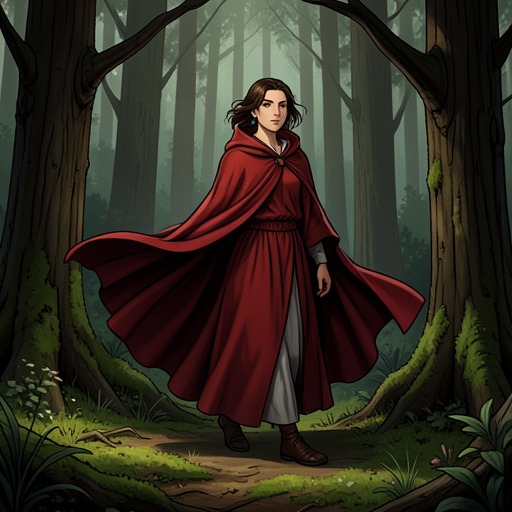
Her First Werewolf (BBW, Werewolf, Prince Charming, Fairy Tale Romance)Flora’s red velvet cloak is both a cherished possession and a narrative sign of identity. Its rich red color causes the townspeople to call Flora “Red,” a nickname she dislikes, while the garment accompanies her from the poverty of her mother’s cabin toward the forest journey that brings her into contact with Charles and the hidden world of the Werewolf. The cloak therefore marks Flora publicly even as she insists on the name she chose for herself.
Origin and Material Value
Flora received the cloak from a trader when she was fourteen. He had stayed with Flora and her mother for a time and had taken more than eggs from Flora’s mother in trade, making the cloak part of an unequal but memorable exchange. Because new fabric was too expensive for the household, the red velvet became Flora’s most prized possession rather than merely another article of clothing.
The cloak’s value is intensified by the surrounding details of domestic scarcity. At the time of the proposed town-hall party, Flora wears a plain dark-brown dress whose modest top has become too small, while the household lacks the resources to make a replacement. Against that worn dress, the cloak represents unusual richness: it is a rare object acquired through exchange, preserved as a possession, and capable of making Flora appear distinct even when her daily life is defined by fieldwork, milking cows, baking, and mending.
Name, Body, and Public Identity
The cloak produces Flora’s public nickname, but it does not determine her private sense of self. Her real name, Flora, refers to field flowers, and she prefers it despite recognizing that some people might find it romantic or silly. The contrast between Flora and “Red” separates the inward identity she values from the outward label imposed by the community. The cloak makes her legible to other people before they know her thoughts, education, or resistance to marriage.
That tension parallels Flora’s broader conflict with expectations for a young woman. Her mother sees the upcoming town-hall party as a chance for Flora to begin a new life, marry well, and escape a future of exhausting rural labor. The cloak helps make such a social presentation possible, yet Flora’s resistance is not simply a matter of appearance. She questions whether marriage would leave her able to read and think for herself, drawing on the books and independent judgment her father encouraged. The garment thus participates in a process of display that Flora does not fully accept.
The Cloak and the Journey to Grandmother’s House
Two days after the discussion of the party, Flora’s mother sends her to her grandmother’s house beyond the forest, carrying a basket of bread, jams, honeys, and shepherd’s pie. Her mother specifically gives her the cloak for the journey and urges her to ask the wealthy grandmother for help in an indirect way, so that the grandmother will believe the request was her own idea. The cloak is consequently tied to a practical objective: securing money or assistance for a dress suitable for the town-hall party.
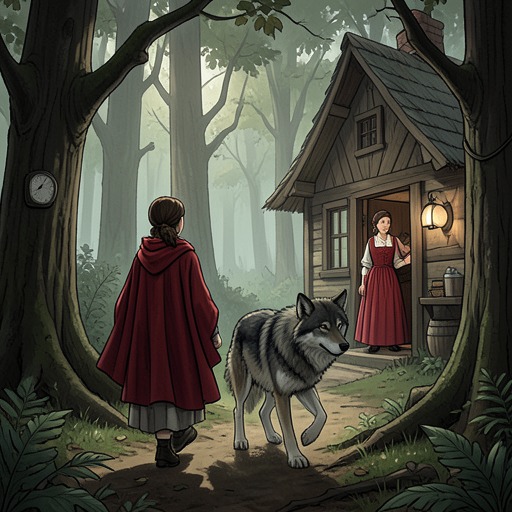
The journey follows the recognizable structure of the Little Red Riding Hood motif. Flora leaves the small town for a grandmother’s house past the forest, and her mother warns her, “Don’t stray from the path!” Flora nevertheless pauses for flowers in a clearing, partly because they may please her grandmother and partly because they may be the last flowers before Winter. The red garment, the maternal dispatch, the forest road, and the grandmother’s destination establish the fairy-tale pattern before the narrative alters it.
The cloak also travels with the heavily loaded basket, making Flora’s movement a material burden as well as a symbolic one. She shifts the basket from one arm to the other because the food weighs her down, while the cloak identifies her against the changing leaves of late Summer. Her path is therefore shaped simultaneously by domestic labor, family obligation, seasonal change, and the possibility of social advancement.
Forest Encounter and Transformation of the Motif
In the forest, Flora becomes increasingly uneasy when the birds stop singing and the surroundings fall silent. To reassure herself, she lists things that do not exist, including fairies, trolls, and Werewolves. Soon afterward, a deep voice addresses her, and she turns to find a tall, handsome man with dark hair and green eyes. The red cloak helps place this encounter within the story’s familiar fairy-tale frame, but the stranger is not presented as a simple animal threat.
The man is Charles, whose fine clothing and broad shoulders distinguish him from a farmer or herdsman. Later, when a black snake threatens Flora, Charles changes into a large, black-furred Wolf and kills the twenty-foot snake in a single bite. The transformation converts the expected figure of the wolf from an external predator into a hidden identity within the handsome male companion. The cloak’s traditional visual signal remains, but its narrative function changes: instead of leading only toward danger, it leads Flora toward an erotic and romantic encounter with a Werewolf.
Social Ascent and Narrative Significance
Charles eventually tells Flora that he wants to take her away to his castle in Endenbrook. The cloak thus stands at the threshold between two social worlds: the humble household where it was obtained through eggs and labor, and the aristocratic setting implied by a castle and Charles’s family. It does not itself create Flora’s transition, but it is the object that visibly accompanies her from one world toward the other.
As a material object, the cloak holds together several tensions in Flora’s story. It is a gift produced through barter, a source of unwanted public naming, a tool in her mother’s plan to make her marriageable, and a marker in a deliberate reworking of the Little Red Riding Hood motif. Its red color makes Flora conspicuous, yet the journey reveals that the most important transformation is not her appearance. The cloak frames the movement from a life organized by poverty and marriage pressure toward a relationship and destination that challenge the rules Flora had once defended.